

Leader journey
Build reliability, not reminder loops.
The journey helps leaders see the cost of follow-up, diagnose reliability gaps, redesign agreements, and install NFR habits in live work. It follows the same three-week, nine-chapter structure as the original portal, but with richer visual context and clearer framing.
3 weeks9 chaptersVisible behavior change
Program length
3 weeksA focused leadership cadence designed to move from awareness to live operating change.
Chapter count
9 chaptersA full sequence covering cost, trust, agreements, visibility, calendar discipline, and proof.
Development outcome
Visible behavior change
Leaders should commit more carefully, escalate earlier, and reduce the need for routine reminders.
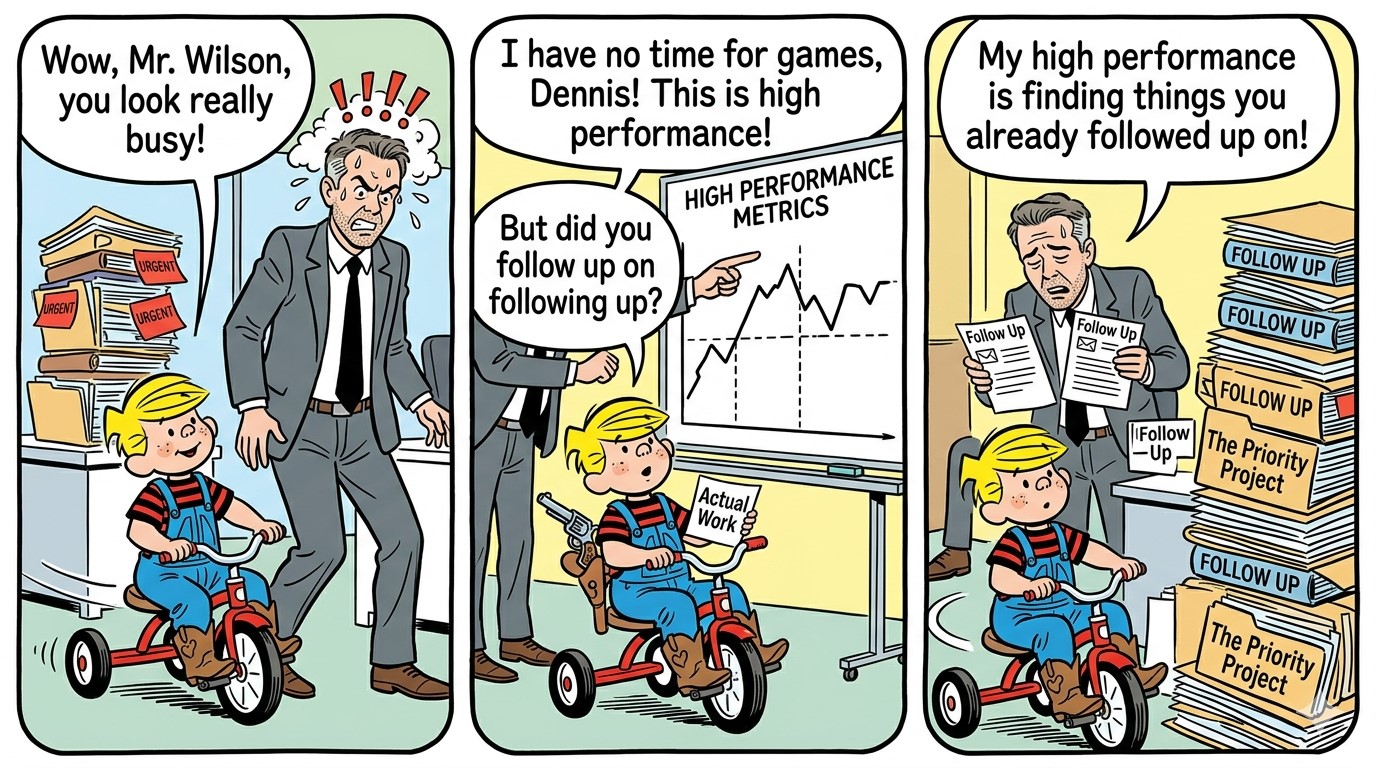
Comic relief
Humor helps the lesson land faster.

Week 1
See the cost. Reset the mindset.
Week 1 reframes follow-up as a drain on time, trust, morale, and pace, then introduces the disciplines that replace chasing with reliability.
Chapter 150 min
The Hidden Cost of Follow-Up
Explain why recurring follow-up is a hidden management cost rather than a harmless coordination habit.
Chapter 255 min
Trust, Reliability, and Survival Mode
Show how unreliable commitments create survival behaviors and why NFR is fundamentally a trust architecture.
Chapter 355 min
The Four NFR Pillars
Use the pillars as a practical framework for reducing reminder-driven work in current leadership loops.
Week 2
Map the loop. Redesign the system.
Week 2 turns NFR into a management system by auditing loops, identifying causes, and redesigning agreements, visibility, and communication.
Chapter 460 min
The Personal Follow-Up Audit
Build a two-way follow-up map and rank the loops that create the greatest drag on leadership attention.
Chapter 560 min
Design SLAs and Promises
Convert vague dependence into explicit response logic, ownership, timing, and commitment quality.
Chapter 655 min
Communicate Early. Make Truth Visible.
Design update rhythms and one trusted source of truth that reduce status-chasing and defensive follow-up.
Week 3
Install it. Prove it. Earn it.
Week 3 moves from design to proof: protect reliability in time, improve commitment quality, and build evidence for NFRL review.
Chapter 750 min
Lead from the Calendar
Turn critical commitments into protected calendar reality rather than hoping urgency will carry them through.
Chapter 855 min
Commit Thoughtfully Under Pressure
Negotiate more honestly, protect capacity, and avoid casual yeses that turn into avoidable follow-up later.
Chapter 960 min
30-Day NFRL Proof
Run a focused implementation cycle and build the evidence pack that shows reliability has actually improved.
Supporting habits
The small habits matter because pressure always returns.
Drop vague language and replace it with explicit dates, times, and completion conditions.
Share progress and risk before people ask. If a deadline is at risk, communicate at least 48 hours ahead.
Use visible tools, shared dashboards, and calendars to make reliability easier than reminder loops.
Application focus
Every week ends with a real operating move.
Week 1: name the cost of follow-up in your own leadership context.
Week 2: redesign one active relationship through SLAs, promises, and update rhythm.
Week 3: install the fix, capture evidence, and prepare for internal recommendation or review.
Suggested flow
Convert understanding into a live redesign.
Once the journey is clear, the next step is not more reading. It is mapping one real relationship in the workbook and designing a cleaner operating loop.